Zuranolone and the neuroactive steroids: a different way to turn up GABA
Zurzuvae acts on the same receptor family as benzodiazepines but at a different site and on more receptor types. That difference, and the brexanolone story before it, explains its 14-day course for postpartum depression.
Key points
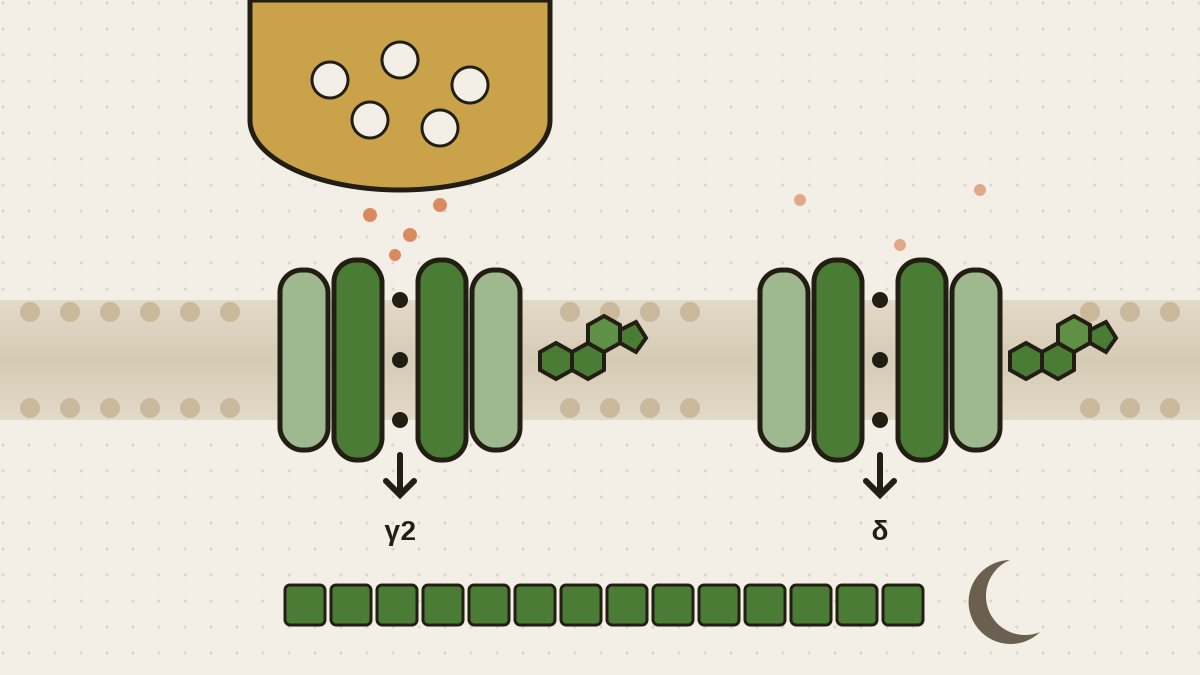
- Zuranolone is a neuroactive steroid that positively modulates GABA-A receptors. Unlike benzodiazepines, which need a γ2 subunit, it also acts on δ-containing extrasynaptic receptors that carry tonic inhibition.
- The approved regimen is 50 mg once each evening with fat-containing food for 14 days. Two placebo-controlled trials showed a roughly 4-point HAMD-17 advantage at day 15. Safety beyond 14 days in one course has not been established.
- A boxed warning bars driving for at least 12 hours after each dose. Brexanolone, the 60-hour IV infusion that came first, left the U.S. market at the end of 2024.
When the FDA approved Zurzuvae (zuranolone) on August 4, 2023, it became the first oral drug for postpartum depression. Its predecessor, brexanolone, needed a 60-hour infusion in a certified facility. Both belong to a class that many clinicians still file mentally under "a benzodiazepine for depression." The pharmacology says otherwise, and the difference helps explain how the drug is used.
Same receptor, different site
GABA-A receptors are chloride channels built from five subunits. The common synaptic forms contain a γ2 subunit and cluster under GABA-releasing terminals, where they produce brief, phasic inhibition. Extrasynaptic forms, many of which contain a δ subunit instead of γ2, sit outside the synapse. They respond to low ambient GABA and produce a steady, tonic inhibition that sets a neuron's overall excitability.
Benzodiazepines bind at the interface between an α and the γ2 subunit. No γ2, no benzodiazepine effect, so δ-containing extrasynaptic receptors are essentially insensitive to them. Neuroactive steroids such as allopregnanolone bind elsewhere, at sites within the membrane-spanning part of the receptor, and they enhance both receptor populations. In the preclinical work published by Sage scientists in 2020, zuranolone potentiated GABA currents at nine recombinant human receptor subtypes, including γ-containing synaptic and δ-containing extrasynaptic types. At α1β2γ2 receptors its effect was synergistic with diazepam, consistent with separate binding sites. In brain slices it also produced a sustained rise in GABA currents that the authors attributed to more receptors reaching the cell surface.
The label itself is more cautious. It says the antidepressant mechanism "is not fully understood" but is thought to relate to positive allosteric modulation of GABA-A receptors.
Why postpartum depression came first
Allopregnanolone is a metabolite of progesterone. Its levels rise steeply in pregnancy and fall after delivery. The working hypothesis is that some women are vulnerable to this abrupt withdrawal of a natural GABA-A modulator, and that restoring the signal for a period can reset mood. That remains a hypothesis rather than an established cause of postpartum depression, but it made the condition a logical first target.
Brexanolone is a formulation of allopregnanolone itself. The FDA approved it as Zulresso on March 19, 2019, as a continuous 60-hour IV infusion, under a REMS because of excessive sedation and sudden loss of consciousness. Patients had to be monitored in a certified facility for the whole infusion. Uptake was limited. Sage stopped selling Zulresso at the end of 2024, and the FDA withdrew the approval at the company's request effective April 14, 2025.
Why 14 days
Zuranolone was designed as an oral analog with a terminal half-life of roughly 20 to 25 hours, which suits once-daily dosing. The 14-day course is simply what was tested and shown to work, not a figure derived from a known biological clock. Both registration trials enrolled women with severe postpartum depression (HAMD-17 of 26 or more) and gave drug or placebo each evening for 14 days:
| Trial | Dose | HAMD-17 change at day 15, drug vs placebo | Difference |
|---|---|---|---|
| SKYLARK (NCT04442503), Am J Psychiatry 2023 | 50 mg (approved formulation) | −15.6 vs −11.6 | −4.0 |
| NCT02978326, JAMA Psychiatry 2021 | 30 mg of an earlier formulation (≈ 40 mg Zurzuvae) | −17.8 vs −13.6 | −4.2 |
Figures are from the label. Separation from placebo appeared within days, and in the 2021 trial the advantage persisted through follow-up at day 45, a month after the last dose. The label states that safety and effectiveness beyond 14 days in a single course have not been established. Zuranolone can be given alone or added to an oral antidepressant. In August 2023 the FDA declined to approve it for major depressive disorder, so the indication is postpartum depression in adults only.
The cost of a broad GABA effect
Enhancing tonic and phasic inhibition together brings CNS depression. In SKYLARK, somnolence occurred in 36% of patients on zuranolone versus 6% on placebo, and dizziness in 13% versus 9%. Driving-simulator studies in healthy adults showed dose-dependent impairment. The boxed warning tells patients not to drive or do other hazardous activities until at least 12 hours after each dose, and notes they may not be able to judge their own impairment. The drug is Schedule IV. The dose drops to 30 mg with strong CYP3A4 inhibitors, severe hepatic impairment or eGFR below 60, and CYP3A4 inducers should be avoided. The label allows a reduction to 40 mg if CNS depressant effects occur.
Sources
- Zurzuvae (zuranolone) capsules, prescribing information — U.S. Food and Drug Administration (FDALabel)
- Preclinical characterization of zuranolone (SAGE-217), a selective neuroactive steroid GABA-A receptor positive allosteric modulator (Althaus et al., Neuropharmacology 2020) — UCL Discovery
- Zuranolone for the treatment of postpartum depression (Deligiannidis et al., Am J Psychiatry 2023) — American Journal of Psychiatry
- Effect of zuranolone vs placebo in postpartum depression: a randomized clinical trial (Deligiannidis et al., JAMA Psychiatry 2021) — PubMed Central
- FDA approves first treatment for post-partum depression — U.S. Food and Drug Administration
- Sage Therapeutics; withdrawal of approval of a new drug application for Zulresso (Federal Register, March 14, 2025) — Federal Register (govinfo)
More from How It Works
- GLP-1 drugs and addiction: what the reward-circuit idea predicts and what trials show
- Two years into Cobenfy: how a muscarinic agonist treats psychosis without blocking D2
- Oveporexton turns the insomnia drugs' target into a wake switch for narcolepsy
- How centanafadine works: a triple reuptake inhibitor tuned toward norepinephrine