Roland Kuhn found the first tricyclic. A 2019 inquiry showed how he tested drugs
A Swiss asylum psychiatrist saw Geigy's would-be antipsychotic G 22355 lift depression, opening the antidepressant era. Historians later documented his drug testing on thousands of patients without consent.
Key points
- Roland Kuhn (1912–2005), a psychiatrist at the cantonal hospital in Münsterlingen, Switzerland, was given Geigy's compound G 22355 as a possible antipsychotic. It did little for psychosis, but he saw it lift depression.
- His August 1957 report on about 40 patients introduced imipramine (Tofranil), the first tricyclic antidepressant and a template for drug treatment of depression for decades.
- A historical study commissioned by the canton of Thurgau, released in September 2019, found that Kuhn tested at least 67 substances on at least 3,000 patients between 1946 and 1980, mostly without their knowledge or consent. The canton apologized and later set up payments to survivors.
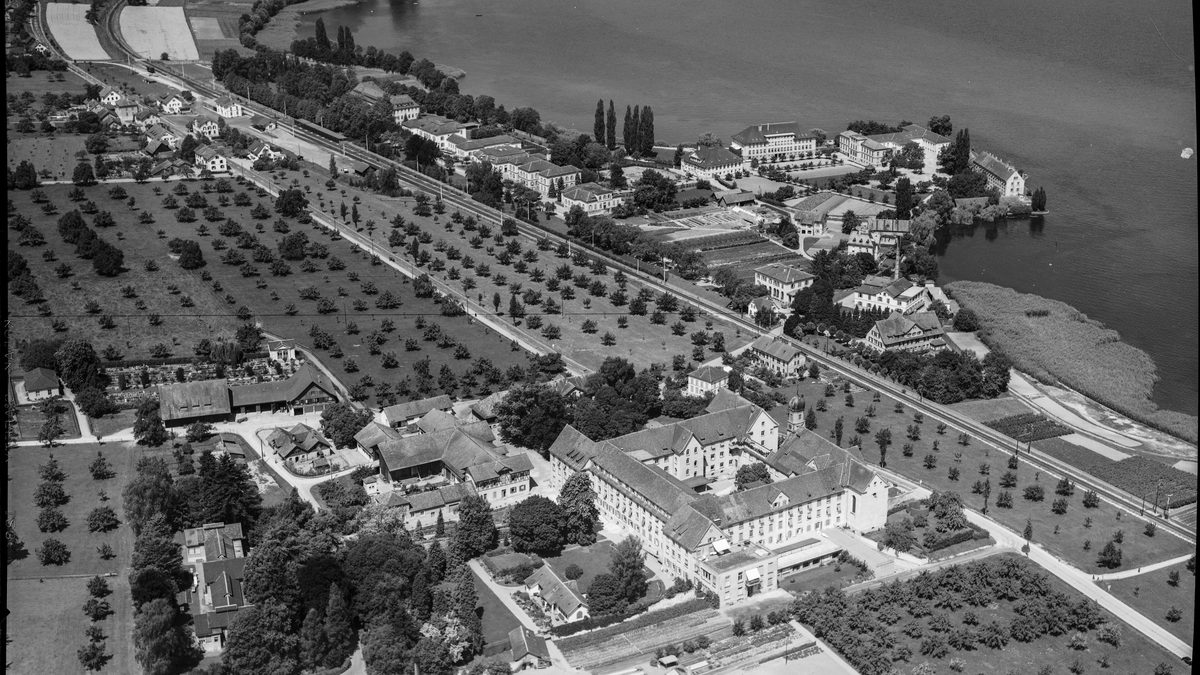
Roland Kuhn was born in Biel on 4 March 1912 and studied medicine in Basel. He came to psychiatry with an interest in phenomenology: before the drug work he wrote on the Rorschach test and on Daseinsanalysis, an existential school of psychotherapy. He spent his career at the psychiatric hospital in Münsterlingen, on the shore of Lake Constance, first as a senior physician and from about 1970 as its director, until 1980.
An antipsychotic that wasn't
Chlorpromazine reached Swiss asylums in the early 1950s, and Münsterlingen used it eagerly, but it was expensive. Drug companies began looking for similar molecules. Geigy had a series of iminodibenzyl compounds structurally close to chlorpromazine, and sent one of them, G 22355, to Kuhn and other psychiatrists. Accounts differ on whether the initiative came from Kuhn or from Geigy's own scientists.
Tested as an antipsychotic in patients with schizophrenia, G 22355 largely failed. Some patients even became hypomanic on it. Kuhn noticed something else: patients with prominent depressive symptoms seemed to improve. In 1956 he began giving the compound to patients with depression. In Wallace Mendelson's account, the first, a severely depressed woman, was markedly better after six days, and Kuhn's first three patients relapsed when the drug was stopped and improved again when it was restarted.
The 1957 report
On 31 August 1957 the Schweizerische Medizinische Wochenschrift published Kuhn's paper on treating depressive states with G 22355, describing an antidepressant effect in about 40 patients. He presented the work at the World Congress of Psychiatry in Zurich that September, to little attention. In 1958 he published a fuller account in the American Journal of Psychiatry, based on more than 500 psychiatric patients. He called the drug "thymoleptic," since "antidepressant" was not yet a standard term.
Geigy marketed imipramine as Tofranil in Switzerland, then in the United States from 1959. The drug's three-ring structure gave a name to the tricyclic class, and its effects on monoamine reuptake later became a cornerstone of the monoamine hypothesis of depression. Kuhn said he could not yet explain how the drug worked. His method relied on close clinical description of individual patients, not controlled comparison.
The Münsterlingen inquiry
Kuhn died in Scherzingen on 10 October 2005. The canton of Thurgau commissioned an independent team from the University of Zurich, led by historian Marietta Meier, to study drug testing at Münsterlingen. Drawing on the clinic's archives, the private papers of Kuhn and his wife, Verena Kuhn-Gebhart, and the archives of Novartis (successor to Geigy), the team released a roughly 300-page report on 23 September 2019.
According to swissinfo.ch and SRF reporting on the findings:
- From 1946 to 1980, at least 3,000 patients received at least 67 substances, some never brought to market; some test groups reached up to 1,000 people.
- Patients were rarely told what they were receiving and were rarely asked for consent. Children, adolescents and people with serious chronic illness were among those tested.
- Drug companies paid Kuhn millions of francs. Jakob Stark, then president of Thurgau's cantonal government, said that from the mid-1960s Kuhn's methods no longer met scientific standards, yet authorities and industry continued to allow and even finance the work.
- The trials were linked to medical complications and deaths, though the causes of some deaths could not be established.
The Thurgau government apologized to those affected in autumn 2019. In April 2023 the cantonal parliament approved a solidarity payment of 25,000 Swiss francs for each surviving person tested at Münsterlingen, with the first payments expected from 2025. The historians later published an English-language book on the case, On Trial: Testing New Drugs in Psychiatry, 1940–1980 (Manchester University Press, 2024).
Legacy
Kuhn's careful observation of a drug that failed at its intended job gave psychiatry its first tricyclic antidepressant. The same hospital records show patients who were never asked. His story is now told with both parts, and it shows why consent, independent oversight and controlled design became requirements of drug research.
Sources
- Über die Behandlung depressiver Zustände mit einem Iminodibenzylderivat (G 22355) (Kuhn R, Schweiz Med Wochenschr 1957;87:1135–1140) — PubMed
- The treatment of depressive states with G 22355 (imipramine hydrochloride) (Kuhn R, Am J Psychiatry 1958;115:459–464) — PubMed
- Roland Kuhn—100th birthday of an innovator of clinical psychopharmacology (Steinberg H, Himmerich H, Psychopharmacol Bull 2012) — PubMed Central
- A history of antidepressants: the tricyclics (Mendelson WB, 2020) — Psychology Today
- Swiss canton apologises for drug tests on psychiatric patients (23 September 2019 report) — swissinfo.ch
- Pionierkanton Thurgau: Opfer von Medikamenten-Tests werden entschädigt (19 April 2023) — SRF News