Oveporexton turns the insomnia drugs' target into a wake switch for narcolepsy
Suvorexant and its cousins block orexin receptors to help people sleep. Takeda's oveporexton does the opposite at orexin-2 receptors, replacing a signal that narcolepsy type 1 has destroyed.
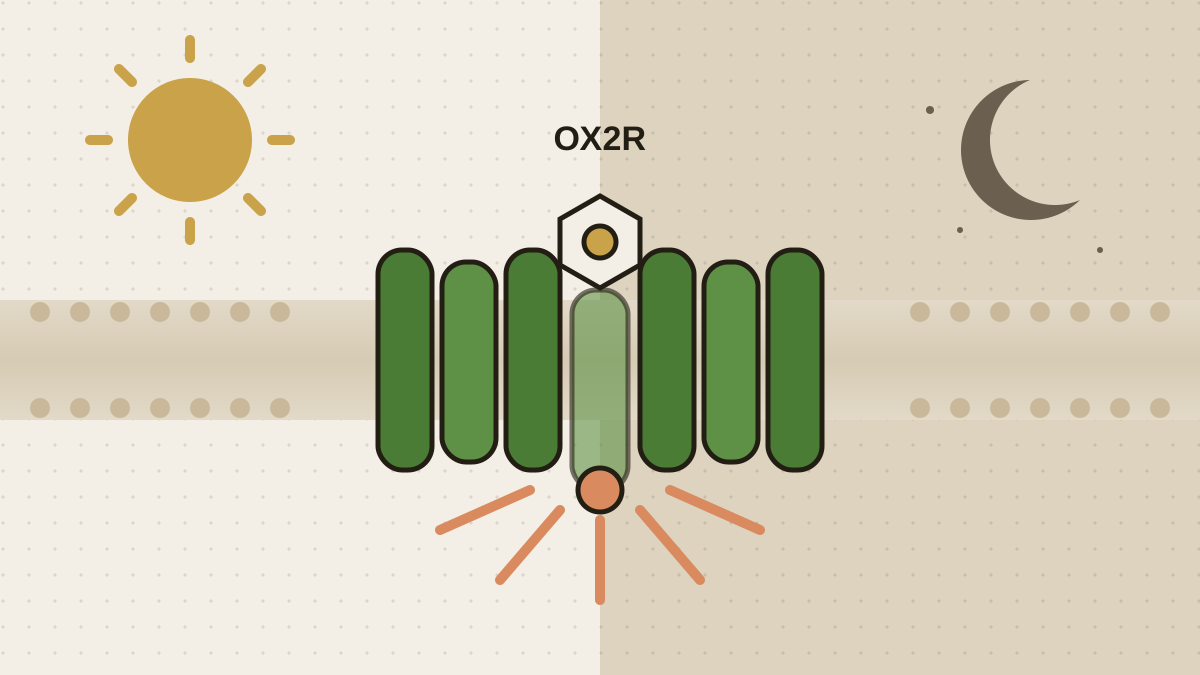
Key points
- Narcolepsy type 1 is caused by loss of the hypothalamic neurons that make orexin (hypocretin). Oveporexton is an oral, selective orexin-2 receptor agonist that stands in for the missing signal.
- In two 12-week phase 3 trials it lengthened MWT sleep latency by about 14 to 20 minutes, versus essentially no change on placebo, and improved sleepiness and cataplexy.
- Its common side effects are what more orexin signaling would predict: insomnia, urinary urgency and frequency, excess salivation, and early rises in blood pressure and heart rate.
Psychiatrists know the orexin system mostly through insomnia. Suvorexant, lemborexant and daridorexant are dual orexin receptor antagonists (DORAs). They quiet a wake-promoting signal so patients can fall and stay asleep. On August 5, 2026, the FDA approved a drug that pushes the same system the other way. Takeda's oveporexton (TAK-861, brand name Orzeyful) is an orexin-2 receptor agonist for adults with narcolepsy type 1 (NT1). It is the first approved drug that activates orexin receptors at all.
A small population of neurons with a large job
Orexin A and orexin B, also called hypocretin 1 and 2, are neuropeptides. They are made only by a small cluster of neurons in the lateral hypothalamus. Those neurons project widely, to histaminergic cells in the tuberomammillary nucleus, noradrenergic locus coeruleus, serotonergic raphe, dopaminergic VTA and cholinergic basal forebrain. Their job is to stabilize wakefulness, holding the brain in the waking state rather than letting it flicker into sleep.
In NT1 those neurons are largely gone, probably through an immune-mediated process. Cerebrospinal fluid orexin is low or undetectable. Without orexin, the boundaries between states blur. Patients have crushing daytime sleepiness, broken nighttime sleep, and REM fragments in waking life: cataplexy, sleep paralysis and hypnagogic hallucinations. Narcolepsy type 2 lacks cataplexy and usually has normal orexin levels, and it is not part of this approval.
Older treatments act downstream. Modafinil, stimulants, pitolisant, sodium oxybate and solriamfetol each push on a monoamine, histamine or GABA-B lever. Oveporexton goes to the top of the pathway. The receptors are still present after the neurons are lost, so a drug can activate them directly.
Why orexin-2, and why selectivity matters
There are two orexin receptors. OX2R is the one most tied to sustained wakefulness, partly through the histaminergic tuberomammillary nucleus. Preclinical work describes oveporexton as highly selective for OX2R over OX1R. In mouse brain slices it depolarized histaminergic neurons. The class has had setbacks. Takeda's earlier oral OX2R agonist, TAK-994, improved wakefulness in a phase 2 trial but was stopped for hepatotoxicity. Oveporexton is a different molecule, and the FDA review will be the place to read how its liver data were judged.
The trials
Approval rested on two randomized, double-blind, 12-week trials. FirstLight enrolled 168 adults across 1 mg twice daily, 2 mg twice daily and placebo. RadiantLight enrolled 105 adults randomized 2:1 to 2 mg twice daily or placebo. Entry required an Epworth Sleepiness Scale (ESS) score of 11 or higher and at least four cataplexy episodes a week. Takeda reported p < 0.001 for all primary and secondary endpoints at every dose.
- Maintenance of Wakefulness Test: mean sleep latency rose 14.3 to 19.8 minutes, versus -0.4 to -0.8 minutes on placebo.
- Subjective sleepiness: 67% to 84% of treated patients reached a normal ESS (10 or below), versus 12% to 17% on placebo.
- Cataplexy: weekly episodes fell significantly versus placebo.
On-target side effects
The adverse-effect profile follows from the mechanism. The most common reactions were insomnia, more frequent urination, urinary urgency and excess salivation. Insomnia is the predictable cost of a wake-promoting agonist, which is why both doses are taken early in the day. Orexin signaling also reaches autonomic centers. The label warns that blood pressure and heart rate can rise, mostly early in treatment, and advises periodic checks. The urinary and salivary effects fit an autonomic explanation, though the precise pathway has not been established. Asymptomatic creatine phosphokinase elevations above 5 times the upper limit of normal occurred in 11% of treated patients versus 5% on placebo, and the label lists them as a warning.
Dosing and kinetics
The label allows 1 mg or 2 mg on waking, followed by a second equal dose 3 to 5 hours later, up to 4 mg a day. Oveporexton is metabolized by CYP3A4. Strong CYP3A inhibitors are contraindicated, and moderate inhibitors or inducers may require dose changes. The label advises avoiding it in severe hepatic impairment (Child-Pugh C) and in severe renal impairment requiring dialysis.
When it reaches patients
Oveporexton launched in Japan and China in October 2026. In the US it cannot be sold until the DEA assigns a controlled-substance schedule. Takeda said in mid-October that it expects a US launch next month, after scheduling is complete.
Sources
- FDA approves Orzeyful for adults with narcolepsy type 1 — Takeda
- NDA 220860 multidiscipline review (oveporexton) — U.S. Food and Drug Administration
- Positive results from phase 3 studies of oveporexton in narcolepsy type 1 — Takeda
- First orexin agonist launches in Japan and China for narcolepsy type 1 — Takeda
- TAK-994 mechanistic investigation into drug-induced liver injury — PubMed Central