Thirty points and a copyright notice: the rise and enclosure of the MMSE
The Folsteins and Paul McHugh built a 10-minute bedside cognitive test in 1975. It spread everywhere for free, until its copyright was enforced and clinicians went looking for alternatives.
Key points
- Marshal Folstein, Susan Folstein and Paul McHugh published the Mini-Mental State Examination in 1975 as a short, purely cognitive bedside test for patients who could not tolerate long batteries.
- For a quarter century it circulated freely. From 2000 its authors enforced their copyright, and in 2001 Psychological Assessment Resources (PAR) took an exclusive license to publish it.
- The free MoCA (2005) and SLUMS (2006) were better at detecting milder impairment, and became the tools many clinicians reached for instead.
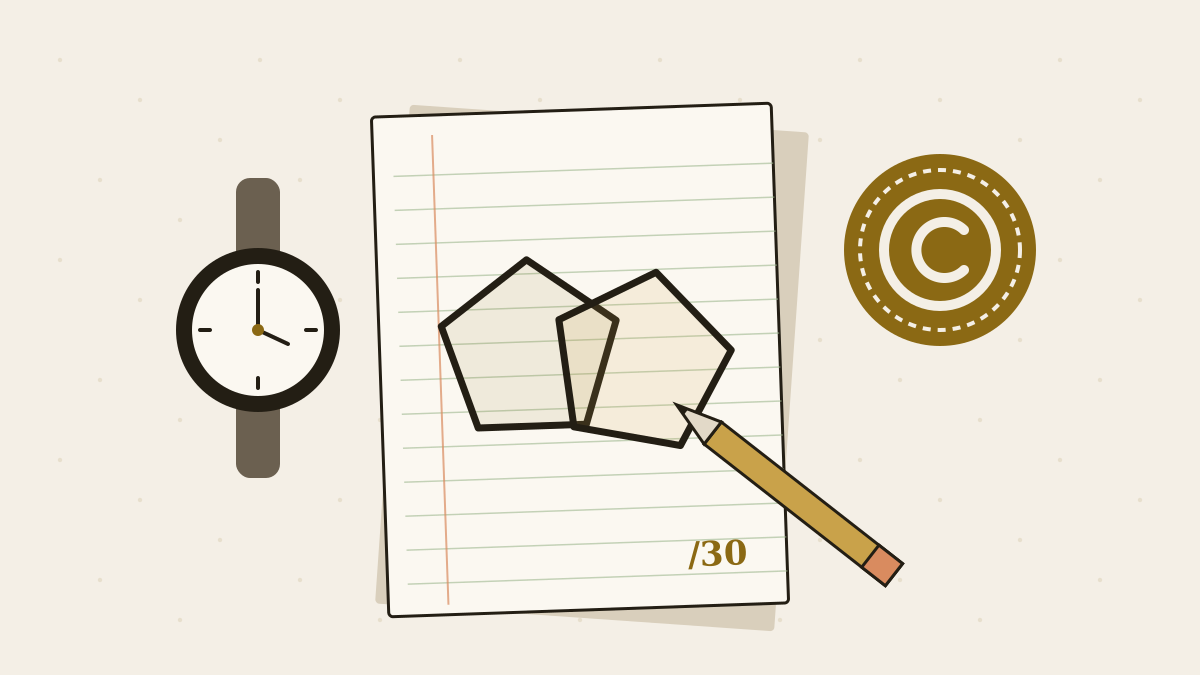
Generations of trainees learned cognitive assessment from the same sequence: the date and place, three words to remember, serial sevens, a pencil and a watch to name, a sentence to write and two intersecting pentagons to copy. The Mini-Mental State Examination became so familiar that many clinicians assumed it belonged to everyone. It did not, and the discovery of that fact changed how psychiatry and geriatric medicine screen for cognitive impairment.
A test built for short attention spans
In the mid-1970s, formal cognitive testing meant long neuropsychological batteries. That was a problem for the people who most needed testing. Older patients with delirium or dementia, the authors observed, cooperate well only for short periods. Marshal Folstein, Susan Folstein and Paul McHugh set out to build something a clinician could do in five to ten minutes.
Their paper, "'Mini-mental state': a practical method for grading the cognitive state of patients for the clinician," appeared in the Journal of Psychiatric Research in 1975. Their choices were deliberate. The test left out mood, perception and thought content, which the rest of the psychiatric mental status examination covers, and focused only on cognition. It scored orientation, registration, attention and calculation, recall, language and construction, for a maximum of 30 points.
The design fit its era. It was short, needed no equipment beyond paper and pencil, and gave a single number that could be charted. It was adopted in hospitals, clinics and research, translated into many languages, and used as an entry criterion and outcome in dementia trials. Most clinicians copied it from textbooks, pocket cards and colleagues' photocopies.
The copyright arrives
The MMSE had always been copyrighted, but for years that was not enforced. According to a 2011 New England Journal of Medicine Perspective by John Newman and Robin Feldman, the original authors began enforcing their rights in 2000, transferring the copyright to a company they had formed. In 2001 they gave PAR an exclusive worldwide license to publish and manage the test. Clinicians who wanted to use it legally were now expected to buy official forms; Newman and Feldman reported a price of $1.23 per test at the time. In 2010 PAR released a second edition, the MMSE-2, with standard, brief and expanded versions.
The controversy peaked in 2011. Tamara Fong and colleagues had developed the Sweet 16, a brief open-access cognitive screen validated in two large cohorts and published in the Archives of Internal Medicine. It shared some item types with the MMSE, such as orientation and three-word recall. After PAR objected, the Sweet 16 was taken offline. Newman and Feldman used the episode to warn that many familiar clinical tools sit in a state of "benign neglect" by their copyright holders and could be pulled behind licensing walls at any time. They proposed that tool developers adopt explicit open licenses.
Many clinicians, the authors noted, were either unaware of the restrictions or ignored them. The episode left a lasting lesson: a clinical instrument's legal status is not the same as its popularity.
Filling the gap
The MMSE also had a clinical weakness that made it easier to leave. It was relatively insensitive to mild impairment, particularly in people with more years of education, who can score in the normal range while clearly declining.
The Montreal Cognitive Assessment, published by Ziad Nasreddine and colleagues in 2005, targeted that blind spot. It added executive tasks such as trail-making, a clock drawing and more demanding recall. In the validation study of 94 people with mild cognitive impairment, 93 with mild Alzheimer's disease and 90 controls, the MMSE (using a cut-off of 26) detected 18 percent of the MCI cases, while the MoCA detected 90 percent. Specificity was 100 percent for the MMSE and 87 percent for the MoCA.
The Saint Louis University Mental Status (SLUMS) examination, from Syed Tariq, John Morley and colleagues at the St. Louis VA, was published in 2006. In 702 veterans, both tests performed acceptably for dementia, but the SLUMS was better at detecting mild neurocognitive disorder, with cut-offs adjusted for education.
The licensing story did not end there. In 2019 Nasreddine announced that most clinicians would need to complete paid online training and certification to administer the MoCA, citing concerns about the validity of results and liability. Geriatricians criticized the move as another case of a standard tool being monetized after it became indispensable.
Sources
- "Mini-mental state": a practical method for grading the cognitive state of patients for the clinician (Folstein, Folstein & McHugh, 1975) — Journal of Psychiatric Research (PubMed)
- Copyright and Open Access at the Bedside (Newman & Feldman, N Engl J Med 2011) — UC Law San Francisco Scholarship Repository
- Development and validation of a brief cognitive assessment tool: the Sweet 16 (Fong et al., 2011) — Beth Israel Deaconess Medical Center
- The Montreal Cognitive Assessment, MoCA: a brief screening tool for mild cognitive impairment (Nasreddine et al., 2005) — Journal of the American Geriatrics Society
- Comparison of the Saint Louis University Mental Status Examination and the Mini-Mental State Examination (Tariq et al., 2006) — American Journal of Geriatric Psychiatry
- Creator of brain exam that Trump aced demands new training for testers — KFF Health News