GLP-1 drugs and addiction: what the reward-circuit idea predicts and what trials show
Semaglutide and its relatives may quiet the brain's response to alcohol, and 2026 brought the first positive phase 2 trials. But no GLP-1 drug is approved for addiction, and the mechanism is still a hypothesis.
Key points
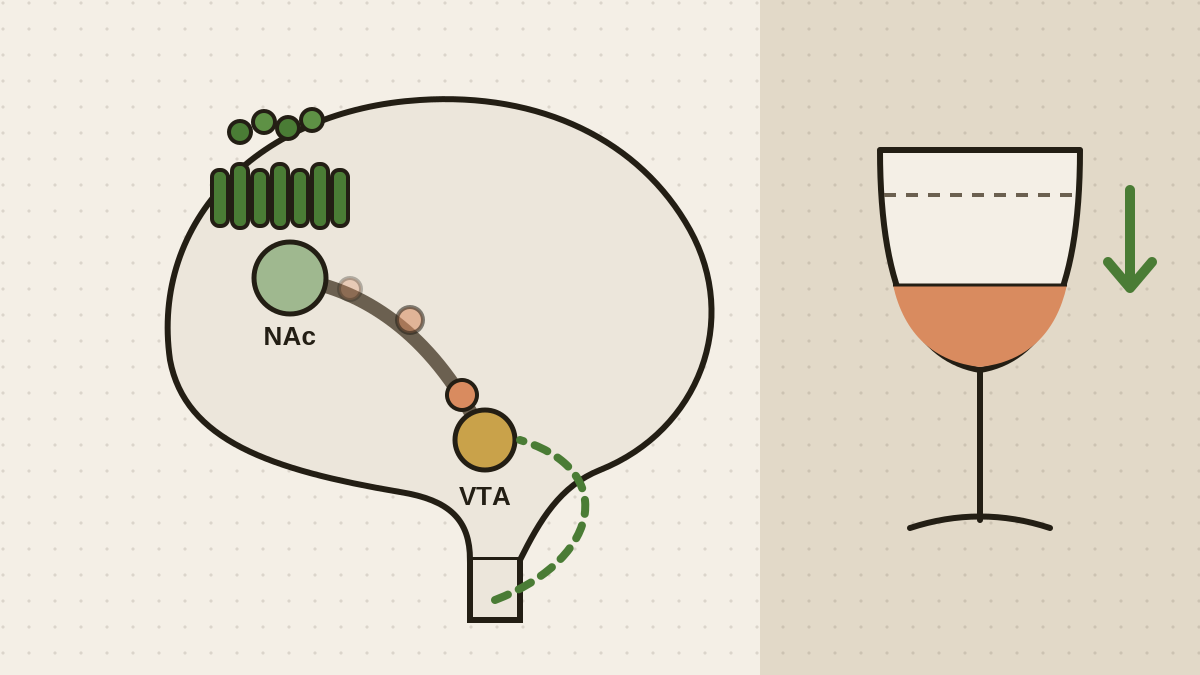
- The hypothesis: GLP-1 receptors in reward circuits damp the dopamine surge and reinforcement that alcohol produces. The evidence for that is mostly from rodents.
- In people, an exenatide trial missed its primary endpoint in 2022. Three semaglutide trials published in 2025 and 2026 reduced some drinking measures, most clearly heavy drinking days in adults with obesity. All were small phase 2 studies.
- No GLP-1 drug carries an addiction indication. In January 2026 the FDA asked makers of the weight-loss products to remove the suicidal ideation warning after its review found no increased risk.
Few ideas in psychopharmacology have spread as quickly as the notion that the weight-loss drugs also curb drinking. Patients describe losing interest in alcohol, and clinicians are asked whether semaglutide can be prescribed for it. The honest answer in November 2026 is that the mechanism is plausible, the trial evidence is encouraging but early, and the drugs are not approved for any substance use disorder.
The mesolimbic hypothesis
Glucagon-like peptide-1 is a gut hormone, but it is also made by neurons in the brainstem's nucleus tractus solitarius, which project to areas that handle reward. GLP-1 receptors are found in the ventral tegmental area and the nucleus accumbens, the core of the mesolimbic dopamine system that most addictive drugs activate.
In rodents, GLP-1 receptor agonists suppress three classic effects of alcohol: the locomotor stimulation, the release of dopamine in the nucleus accumbens, and conditioned place preference, a measure of reward. They also reduce how much alcohol animals drink. A 2023 review by Elisabet Jerlhag summarizes this work. Local infusion studies point most strongly to the accumbens shell, with the brainstem projections to reward areas also implicated.
The proposed picture, then, is a brake on reward rather than an aversive effect. Alcohol still produces intoxication, but its reinforcing pull is weaker. Two points remain unsettled. Large peptides such as semaglutide reach some brain regions far more easily than others, so it is unclear how much drug acts directly on deep reward structures and how much acts through the brainstem and vagal signaling. And nausea or general appetite suppression could explain part of any effect on drinking.
What the human trials show
| Trial | Population | Result |
|---|---|---|
| Exenatide weekly, 26 weeks (JCI Insight, 2022) | 127 treatment-seeking adults with AUD | No reduction in heavy drinking days (primary). Exploratory benefit in participants with BMI above 30. |
| Semaglutide up to 1.0 mg weekly, 9 weeks (JAMA Psychiatry, 2025) | 48 adults with AUD not seeking treatment | Less alcohol consumed in a laboratory drinking session. Fewer drinks per drinking day and less craving. No change in number of drinking days. |
| Semaglutide 2.4 mg weekly plus CBT, 26 weeks (Lancet, 2026) | 108 adults with AUD and obesity | Heavy drinking days fell 41.1 vs 26.4 percentage points, a 13.7-point advantage. |
| Oral semaglutide 3 then 7 mg daily, 8 weeks (Am J Psychiatry, 2026) | 50 treatment-seeking adults with AUD | No significant effect on laboratory craving or drinks per day. Fewer heavy drinking days in the final 4 weeks. |
The exenatide trial matters for the mechanism. Although drinking did not fall overall, exenatide reduced alcohol cue reactivity in the ventral striatum on fMRI, the kind of signal the mesolimbic hypothesis predicts. The Lancet trial is the strongest positive result so far, but its participants all had obesity, received CBT and were followed for six months. Whether the effect holds in people of normal weight is an open question. The exenatide hint that benefit concentrated in heavier patients makes that question more pressing. Larger trials are under way, including a 622-participant trial in veterans (NCT07218354) that has not reported.
Observational data point the same way, with the usual limits. In a Swedish national register study of people with AUD, periods of semaglutide use were associated with a lower risk of AUD hospitalization (adjusted HR 0.64) and liraglutide with a lower risk (0.72), compared with periods off the drugs. The authors themselves called for randomized trials. Healthier, more engaged patients may be the ones who obtain these drugs.
The suicidality question
In July 2023, after postmarketing reports of suicidal thoughts, the FDA began reviewing the class. Its January 2024 preliminary review found no clear signal but could not rule out a small risk. On January 13, 2026, it concluded the review. A meta-analysis of 91 placebo-controlled trials with 107,910 patients found no increase in suicidal ideation or behavior, and none in anxiety, depression, irritability or psychosis. A Sentinel claims study of more than 2.2 million new users found no increased risk of intentional self-harm versus SGLT2 inhibitors. The agency asked the makers of Saxenda, Wegovy and Zepbound to remove the warning. The diabetes-indicated products had never carried it.
Sources
- FDA requests removal of suicidal behavior and ideation warning from glucagon-like peptide-1 receptor agonist (GLP-1 RA) medications — U.S. Food and Drug Administration
- Once-weekly semaglutide in adults with alcohol use disorder: a randomized clinical trial (Hendershot et al., 2025) — JAMA Psychiatry
- GLP-1 drug significantly reduces problem drinking in individuals with AUD, obesity (on Klausen et al., Lancet 2026) — Psychiatric News Alert (American Psychiatric Association)
- Oral semaglutide for alcohol use disorder: a randomized clinical trial (2026) — PubMed (American Journal of Psychiatry)
- Exenatide once weekly for alcohol use disorder investigated in a randomized, placebo-controlled clinical trial (Klausen et al., 2022) — JCI Insight
- Repurposing semaglutide and liraglutide for alcohol use disorder (Lähteenvuo et al., JAMA Psychiatry 2025) — Tampere University research portal
More from How It Works
- Zuranolone and the neuroactive steroids: a different way to turn up GABA
- Two years into Cobenfy: how a muscarinic agonist treats psychosis without blocking D2
- Oveporexton turns the insomnia drugs' target into a wake switch for narcolepsy
- How centanafadine works: a triple reuptake inhibitor tuned toward norepinephrine