From camphor to anesthesia: the long, contested history of electroconvulsive therapy
ECT began with a wrong theory and a vial of camphor in 1934. Its unmodified decades earned it a fearsome reputation; anesthesia and evidence brought it back.
Key points
- Convulsive therapy began in Budapest in January 1934, when László Meduna induced seizures with camphor, then switched to the faster-acting convulsant metrazol (Cardiazol).
- Ugo Cerletti and Lucio Bini gave the first electrically induced treatment in Rome in April 1938. For roughly its first 15 years ECT was given without anesthesia or muscle relaxation.
- Modified ECT, with brief anesthesia and succinylcholine from the early 1950s, transformed its safety. Meta-analytic evidence supports its efficacy in severe depression, and it remains a first-line option for catatonia.
Few treatments in medicine carry as much cultural baggage as electroconvulsive therapy. For many patients, the picture in their head comes from a novel and a film, not from a modern treatment suite with an anesthesiologist, a pulse oximeter and an EEG trace. The gap between those two pictures is the story of how a crude, frightening procedure was rebuilt into one of psychiatry's most effective treatments.
A wrong theory with a useful result
The Hungarian psychiatrist László (Ladislas) Meduna believed that epilepsy and schizophrenia were biologically antagonistic, partly from neuropathology work in which he saw glial changes in epileptic brains but not in those of people with schizophrenia. If the two conditions excluded each other, he reasoned, an induced seizure might push psychosis back.
The theory was wrong. The experiment was not useless. At the Lipótmező hospital outside Budapest, Meduna gave his first patient, a man with long-standing catatonic stupor, a camphor injection on January 23, 1934. Meduna later described a dramatic recovery after a handful of treatments. Camphor was slow and unpredictable, so he soon switched to pentylenetetrazol, sold as Metrazol or Cardiazol.
The record is more complicated than the legend. In 2008, Hungarian researchers re-examined the original case notes of that first patient, known as Zoltán L. The catatonic stupor did resolve after the first course, but the remission lasted only a few months. He relapsed, received repeated courses through 1937, was never discharged, and died in the institute in 1945.
Rome, 1938
Chemical convulsions were frightening for patients. There was often a period of dread before the seizure began. In Rome, the neuropsychiatrist Ugo Cerletti and his colleague Lucio Bini were studying electrically induced seizures in animals, and observations of electrical stunning of pigs at the Rome slaughterhouse helped persuade them that a current applied to the head could produce a seizure without killing. In April 1938 they treated their first patient, an unidentified man with schizophrenia who had been found wandering and could not give an account of himself, using electrodes on the temples. He received a course of treatments and improved.
Electrical induction was quicker, cheaper and more controllable than metrazol, and it spread around the world within a few years.
The unmodified years
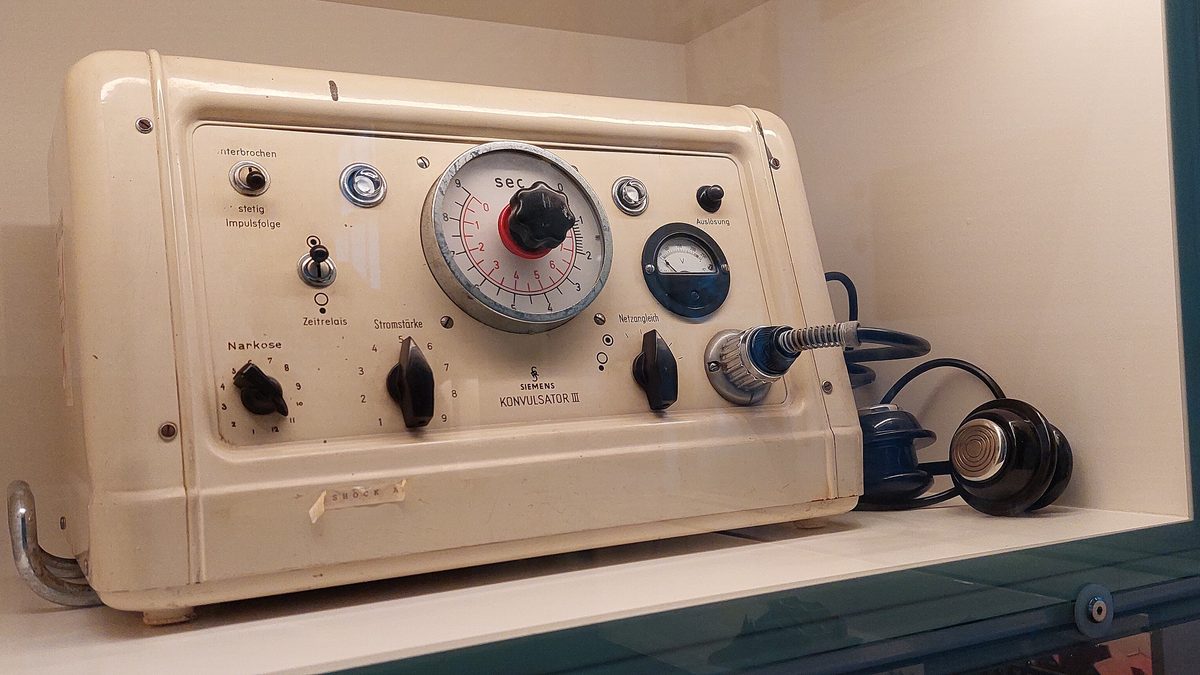
For its first decade and a half, ECT was mostly given "unmodified": no anesthesia and no muscle relaxant. The full tonic-clonic convulsion caused fractures, including vertebral compression fractures, as well as dislocations and dental injuries.
Attempts to soften the convulsion started early. In the early 1940s the American psychiatrist A. E. Bennett used curare to reduce the muscular force of convulsive treatment, but curare was hard to dose safely. The turning point came in the early 1950s, when the short-acting relaxant succinylcholine was introduced, given with a brief barbiturate anesthetic and oxygen. The insight that made this possible was that the benefit came from the seizure in the brain, not the convulsion in the body.
A reputation set in fiction
Ken Kesey's 1962 novel One Flew Over the Cuckoo's Nest, and Miloš Forman's 1975 film, showed ECT used as punishment. The image stuck, and it arrived at a time when antidepressants and antipsychotics were offering alternatives and the anti-psychiatry movement was gaining ground. Use fell sharply. In 1982 voters in Berkeley, California, approved a measure making ECT a misdemeanor in the city. It was overturned in court soon after. A National Institutes of Health consensus conference in 1985 concluded that ECT had a role in specific conditions, but the meeting itself was marked by protest from former patients.
What the evidence says now
The strongest summary remains the UK ECT Review Group's 2003 meta-analysis in The Lancet. Real ECT outperformed sham ECT (six trials, 256 patients), outperformed pharmacotherapy in the short term (18 trials, 1,144 participants), bilateral placement was moderately more effective than unilateral, and higher doses beat lower ones. Cognitive effects, especially memory loss around the treatment period, are real and are the main trade-off. Modern technique, including brief or ultrabrief pulse stimulation and right unilateral placement where appropriate, aims to reduce them.
Regulation has followed. In December 2018 the FDA moved ECT devices from Class III to Class II for catatonia and for severe major depressive episodes in major depressive disorder or bipolar disorder, in patients aged 13 and older who are treatment-resistant or need a rapid response. The newest comparisons are with other rapid treatments: in the 2023 ELEKT-D trial, intravenous ketamine was noninferior to ECT for nonpsychotic treatment-resistant depression, a finding that does not extend to psychotic depression or catatonia.
Sources
- Lessons from an early account of convulsive therapy (Baran et al., 2008) — Archives of Clinical Psychiatry (São Paulo)
- Shock Therapy: A History of Electroconvulsive Treatment in Mental Illness (Shorter & Healy, 2007), book review — British Journal of Psychiatry
- The historical struggles of modified electroconvulsive therapy: how anesthesia came to the rescue (2021) — Journal of Anesthesia History (PubMed)
- Efficacy and safety of electroconvulsive therapy in depressive disorders: a systematic review and meta-analysis (UK ECT Review Group, 2003) — The Lancet (PubMed)
- FDA reclassifies some electroconvulsive devices in final order — MedTech Dive