Two years into Cobenfy: how a muscarinic agonist treats psychosis without blocking D2
Xanomeline stimulates M1 and M4 receptors in the brain, and trospium blocks the same receptors in the body. The pairing explains Cobenfy's efficacy, its side effects and some of its limits.
Key points
- Xanomeline is a muscarinic agonist that prefers M1 and M4 receptors. It reduces psychosis without blocking dopamine D2 receptors. Trospium is a peripherally restricted muscarinic antagonist added to blunt xanomeline's effects outside the brain.
- The common side effects are cholinergic (nausea, vomiting, dyspepsia) or anticholinergic (constipation, urinary retention risk), with tachycardia and hypertension. EPS, prolactin elevation and weight gain were not prominent in the trials.
- As add-on therapy, ARISE missed its primary endpoint in April 2025. The Alzheimer's psychosis (ADEPT) readouts have slipped into 2027. The label is still schizophrenia in adults, as monotherapy.
When the FDA approved Cobenfy (xanomeline and trospium chloride) on September 26, 2024, the agency called it the first antipsychotic for schizophrenia that targets cholinergic rather than dopamine receptors. Two years later the mechanism is still the most interesting thing about the drug. It also explains much of what clinicians have learned since.
Turning down dopamine from upstream
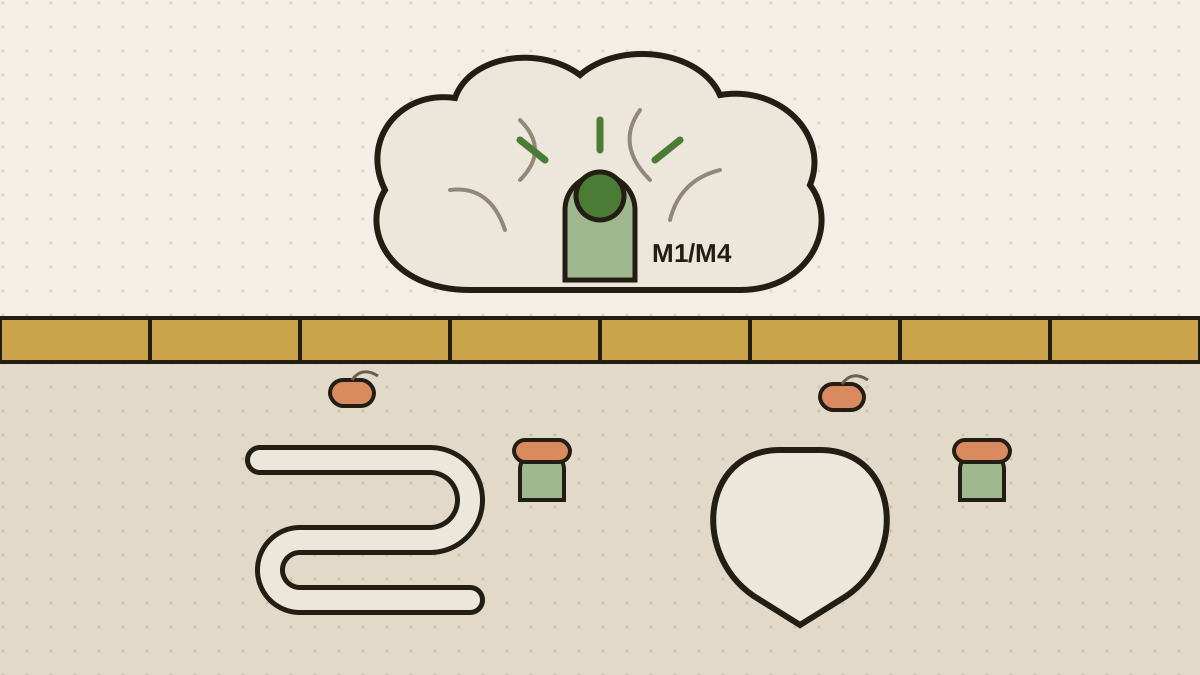
Every earlier antipsychotic, from chlorpromazine to brexpiprazole, works at least partly by blocking or partly agonizing the D2 receptor. Xanomeline does not bind D2 in any clinically meaningful way. It is an agonist with preference for the M1 and M4 subtypes of muscarinic acetylcholine receptor, and the leading model has two parts.
- M4 receptors sit on circuits that regulate striatal dopamine release, including cholinergic inputs to midbrain dopamine neurons and striatal projection neurons. Activating them is thought to reduce excess dopamine release in the associative striatum, the presynaptic abnormality seen on PET in psychosis. The effect is a brake on release rather than a block at the receptor.
- M1 receptors are dense in cortex and hippocampus. M1 agonism may improve cortical signaling and has long been studied as a possible route to cognitive benefit.
Because the striatal D2 receptors are left alone, the usual D2 consequences were not prominent in the trials. That means little parkinsonism or akathisia and no prolactin elevation. Open-label 52-week extension data also showed no meaningful weight gain or metabolic change.
Why trospium is in the capsule
Xanomeline was first studied decades ago for Alzheimer's disease. It reduced psychotic symptoms and agitation, but peripheral muscarinic activation caused nausea, vomiting, sweating and salivation that made it hard to tolerate. The fix was pharmacokinetic. Trospium is a quaternary ammonium antimuscarinic, already used for overactive bladder. Its permanent positive charge keeps it largely out of the brain. Paired with xanomeline, it blocks muscarinic receptors in the gut, salivary glands, sweat glands and bladder, while xanomeline's central agonism continues.
The cancellation is incomplete, and the label shows it. In the two 5-week registration trials, the most common reactions on Cobenfy versus placebo were:
| Adverse reaction | Cobenfy (n = 251) | Placebo (n = 253) | Likely source |
|---|---|---|---|
| Nausea | 19% | 4% | Residual cholinergic stimulation |
| Dyspepsia | 18% | 5% | Cholinergic GI effects |
| Constipation | 17% | 7% | Trospium's antimuscarinic action |
| Vomiting | 15% | 1% | Residual cholinergic stimulation |
| Hypertension | 11% | 2% | Autonomic effects |
The "likely source" column is our mechanistic reading, not label language. Tachycardia, abdominal pain, diarrhea, dizziness and reflux also met the label's threshold of at least 5% and twice placebo. The contraindications come from trospium's side of the capsule: urinary retention, gastric retention and untreated narrow-angle glaucoma. Moderate or severe hepatic impairment is also contraindicated. Use is not recommended when eGFR is below 60 mL/min, because trospium exposure rises.
Dosing reflects the tolerability problem
The label starts at 50 mg/20 mg (xanomeline/trospium) twice daily for at least 2 days, then 100 mg/20 mg twice daily for at least 5 days. The dose can go up to 125 mg/30 mg twice daily. It must be taken at least 1 hour before or 2 hours after a meal. Twice-daily dosing away from meals is an adherence hurdle in this population. Bristol Myers Squibb (BMS) said on its second-quarter 2026 earnings call that slow titration to effective doses and repeat prescribing were limiting Cobenfy's growth.
Efficacy: monotherapy yes, add-on not yet
In the 5-week EMERGENT-2 trial, xanomeline-trospium lowered PANSS total scores 9.6 points more than placebo. EMERGENT-3 was also positive. The adjunctive question has not gone as well. In ARISE, adults with inadequate response to an atypical antipsychotic added Cobenfy or placebo. On April 22, 2025, BMS reported a 2.0-point PANSS advantage at week 6, which was not statistically significant (p = 0.11). A post hoc analysis suggested benefit in patients whose background drug was not risperidone and none in those taking risperidone. That is a hypothesis, not evidence. We found no public record of a follow-up adjunctive trial, and the label has no add-on indication.
The Alzheimer's question, postponed
Xanomeline's story began in Alzheimer's disease, and BMS is testing Cobenfy in psychosis associated with Alzheimer's in the ADEPT program. In December 2025 the company found irregularities at some ADEPT-2 sites, excluded those sites' data and reopened enrollment. On its second-quarter 2026 call, BMS said ADEPT readouts would begin in early 2027, with a possible interim analysis of ADEPT-1 late in 2026. As of this writing, no ADEPT efficacy data have been made public. Cobenfy's only FDA indication remains schizophrenia in adults.
Sources
- FDA approves drug with new mechanism of action for treatment of schizophrenia — U.S. Food and Drug Administration
- Cobenfy (xanomeline and trospium chloride) prescribing information — Drugs.com (FDA label)
- Bristol Myers Squibb announces topline results from phase 3 ARISE trial evaluating Cobenfy as an adjunctive treatment — Bristol Myers Squibb (Business Wire)
- Bristol Myers Squibb announces continuation of ADEPT-2 phase 3 study in psychosis associated with Alzheimer's disease — Bristol Myers Squibb
- Bristol Myers delays Cobenfy Alzheimer's psychosis readout again amid another quarterly beat — Fierce Pharma
- Pooled analysis of the EMERGENT trials of xanomeline and trospium chloride in schizophrenia — PubMed Central