How centanafadine works: a triple reuptake inhibitor tuned toward norepinephrine
Simtriyo blocks norepinephrine, dopamine and serotonin reuptake in a roughly 1:6:14 in vitro ratio. That tilt explains much of what the trials and the label show, from appetite loss to an MAOI contraindication.
Key points
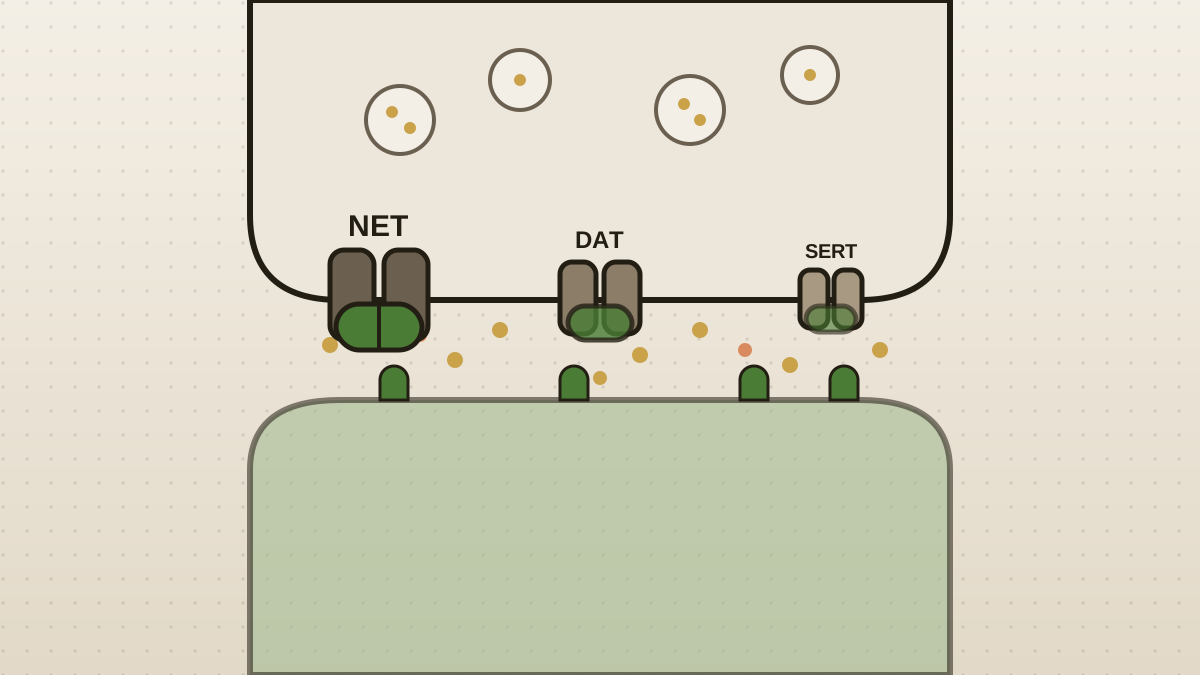
- Centanafadine inhibits the norepinephrine, dopamine and serotonin transporters. In vitro it is about 6 times more potent at NET than DAT and about 14 times more potent at NET than SERT.
- It is a once-daily extended-release capsule with a mean half-life of about 5 hours. It is approved for ADHD in adults and in children 6 and older who weigh at least 20 kg.
- The label carries boxed warnings for suicidal thoughts and behaviors in children and for abuse, misuse and addiction. It is contraindicated with MAOIs. It cannot be marketed until the DEA publishes a scheduling notice.
For decades ADHD pharmacology has come in two flavors. Stimulants release dopamine and norepinephrine or block their reuptake. Non-stimulants such as atomoxetine and viloxazine act mainly on norepinephrine. Otsuka's centanafadine, which the company announced as FDA-approved under the brand name Simtriyo on July 24, 2026, sits between and slightly beside both. It blocks all three monoamine transporters, and Otsuka calls it the first approved norepinephrine, dopamine and serotonin reuptake inhibitor (NDSRI).
Three transporters, unequal weights
A reuptake inhibitor works by occupying the presynaptic transporter that normally clears a neurotransmitter from the synapse. With the transporter blocked, transmitter lingers in the cleft and signals for longer. Centanafadine does this at the norepinephrine transporter (NET), the dopamine transporter (DAT) and the serotonin transporter (SERT), but not equally. Reported in vitro IC50 values are about 6 nM at NET, 38 nM at DAT and 83 nM at SERT. That is roughly a 1:6:14 ratio, with norepinephrine dominant.
Those numbers come from cell assays, and the brain may not read them the same way. A PET occupancy study in healthy men estimated an in vivo NET-to-DAT affinity ratio of about 12 and a NET-to-SERT ratio of about 13. On that estimate, dopamine and serotonin transporter blockade were roughly comparable to each other. Either way, this is a NET-led drug with secondary dopamine and serotonin effects, not a dopamine-releasing stimulant.
The design logic is familiar from ADHD neuroscience. Norepinephrine and dopamine in prefrontal cortex tune working memory and attention. In prefrontal cortex, where DAT is sparse, NET also clears much of the local dopamine. So a NET-weighted blocker can raise prefrontal catecholamines broadly. The serotonin component is the novel part. The trials were not designed to show what, if anything, it adds clinically.
What the pharmacology predicts, and what the label shows
The adverse-effect list reads like a catecholamine and serotonin drug. The most common reactions in adults were headache, decreased appetite, insomnia, nausea, dry mouth and diarrhea. In children 6 to 12 the leading reactions were rash and decreased appetite. In adolescents they were decreased appetite, nausea, rash, headache and abdominal pain.
- Noradrenergic tone: the label tells clinicians to check blood pressure and heart rate after dose increases and periodically. It contraindicates use in pheochromocytoma.
- Serotonergic risk: use with an MAOI, or within 14 days of stopping one, is contraindicated, including linezolid and IV methylene blue. The label warns about serotonin syndrome when the drug is combined with other serotonergic agents.
- Dopaminergic reward: the label carries a boxed warning for abuse, misuse and addiction and calls the drug a CNS stimulant.
- Pediatric suicidality: a second boxed warning reflects higher rates of suicidal ideation and behavior with centanafadine than with placebo in a 6-week study of children 6 to 12.
The label also flags an interaction risk with CYP1A2 substrates and advises monitoring and possible dose reduction of the other drug. Patients are told to avoid alcohol at the time of dosing and for at least 2 hours afterward.
Pharmacokinetics that matter
The mean elimination half-life is about 5.2 hours. That is short enough that the once-daily schedule depends on the extended-release capsule. It comes in 140, 210 and 280 mg strengths. Reference summaries of the label describe adult dosing as 210 mg once daily, which may be raised to 280 mg. Adolescents take 280 mg. Children take 140 to 280 mg depending on body weight. Clinicians should confirm doses against the full prescribing information, which expresses strength as centanafadine base.
The evidence base
Approval rested on four phase 3 trials, two in adults, one in adolescents and one in children. The adult studies, published by Adler and colleagues, enrolled people aged 18 to 55. They used an earlier sustained-release formulation at 200 and 400 mg/day. Both doses beat placebo on the Adult ADHD Investigator Symptom Rating Scale at day 42. In the 6-week adolescent (13 to 17) and child (6 to 12) trials, the high dose separated from placebo on the ADHD-RS-5 starting at week 1. The low dose did not reach significance in either trial.
Still waiting on the DEA
The FDA approval letter makes marketing conditional on a DEA Federal Register notice announcing interim final scheduling. As of late October 2026 we found no such notice. Otsuka has said only that it expects the drug to be available later this year. Until the DEA acts, nobody can say whether centanafadine will carry stimulant-style Schedule II restrictions or a lighter schedule.
Sources
- Otsuka receives FDA approval for first-in-class Simtriyo (centanafadine) for ADHD — Otsuka America Pharmaceutical (Business Wire)
- Simtriyo (centanafadine) extended-release capsules: prescribing information — U.S. Food and Drug Administration
- NDA 218145 approval letter (Simtriyo) — U.S. Food and Drug Administration
- Efficacy and safety of centanafadine for adults with ADHD: results of two phase 3 trials (Adler et al.) — Journal of Clinical Psychopharmacology (PMC)
- Positive topline results from two pivotal phase 3 trials of centanafadine in adolescents and children with ADHD — Otsuka Pharmaceutical (Business Wire)
- In vivo transporter occupancy of centanafadine in healthy adults (PET study) — PubMed Central